Every dairy farmer knows somatic cell count matters. High SCC means lower milk quality, lost premiums, and hidden infection. What most farmers do not have is a reliable, affordable way to measure it cowside — without sending samples to a laboratory and waiting days for results. This SCC test strip delivers objective, numerical results in 15 minutes from a fresh milk sample. No laboratory. No electronic meter. No subjectivity. Just a clear answer, at the right time, where the cow is.
Supplied by BCST — authorized distributor for Bartovation in Thailand.
Somatic cells are white blood cells — the immune system’s frontline response to infection. In healthy udder tissue, somatic cell count in milk is naturally low. When bacterial infection enters the udder, the immune system mobilises white blood cells to combat it. These cells accumulate in the milk. Therefore, the higher the SCC, the more active the immune response — and the more significant the underlying infection.
The consequences of elevated SCC extend beyond the individual cow. High SCC reduces milk quality, alters taste and composition, and shortens shelf life. Furthermore, milk processors and cooperatives set SCC thresholds — farmers whose bulk tank SCC exceeds acceptable limits lose premiums and may face supply rejection. As a result, a single chronically infected cow in a small herd can single-handedly push the bulk tank above compliance thresholds.
The clinical threshold for concern is well established. SCC above 200,000 to 300,000 cells per millilitre is considered abnormal and indicative of subclinical mastitis. Consequently, the goal of proactive management is to identify cows before they reach this threshold — not after.
Routine SCC monitoring makes this possible. However, the challenge has always been access. Laboratory SCC testing is accurate but slow and expensive. Similarly, electronic SCC meters are accurate but require capital investment and technical operation. The California Mastitis Test — CMT — is widely used but relies on subjective gel formation interpretation and only becomes reactive at SCC levels of 700,000 to 1,000,000 cells per millilitre — a point far too late for optimal intervention.
This test was designed to fill that gap. Objective numerical results. Cowside. Fifteen minutes. Affordable enough for routine use.
How SCC Test Strips Work For Dairy Cows
The SCC Cows Milk Test Strip uses a chemical reaction between an enzyme present in somatic cells and a dye on the test pad. As somatic cell concentration increases, the reaction intensifies and produces a deeper blue colour. You then read the result against the colour chart on the vial — objective, consistent, and unaffected by the interpreter’s experience level.
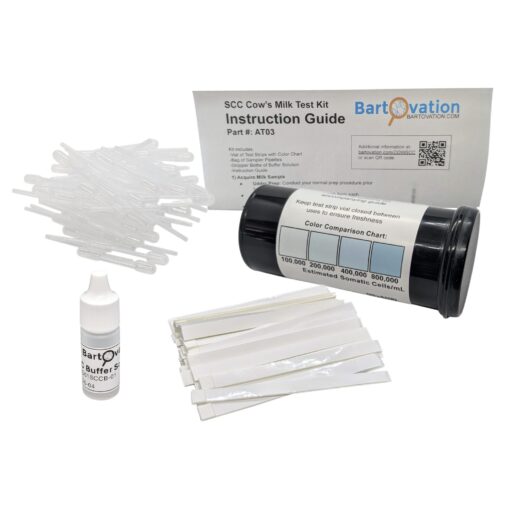
Each kit contains 50 test strips, 50 sampler pipettes, and a chemical buffer solution. In other words, everything you need for 50 complete tests is included.
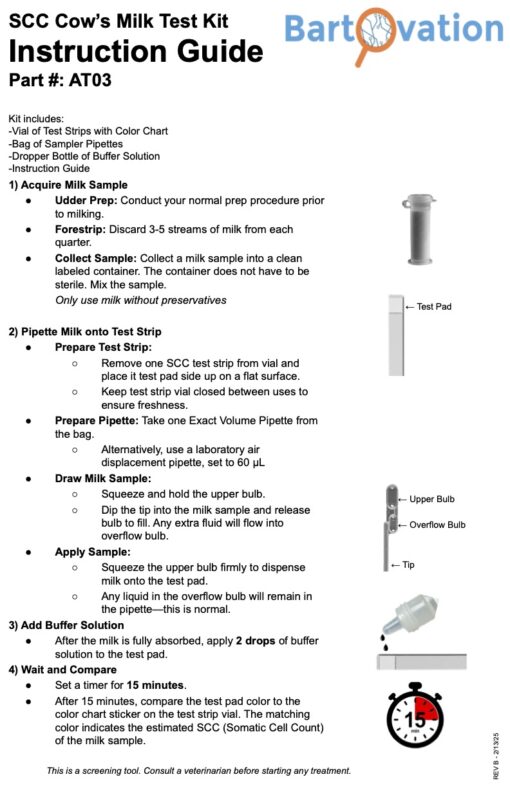
The procedure follows five straightforward steps:
Step 1 — Prepare udder and collect sample. Follow your normal pre-milking udder preparation procedure. Forestrip each quarter 3 to 5 streams. Collect a milk sample in a clean labelled container. Then mix the sample well before testing.
Step 2 — Prepare strip and pipette. Place an SCC test strip on a flat, clean surface. Next, use the provided pipette to draw a milk sample from the container.
Step 3 — Apply milk to test pad. Dispense the milk sample onto the test pad using the pipette. Do not dip the strip directly into milk — accuracy depends on using the correct volume. Additionally, do not add excess milk as this will affect results.
Step 4 — Add buffer solution. Once the milk absorbs into the test pad, apply 2 drops of the provided buffer solution directly onto the pad.
Step 5 — Wait and read. Set a timer for 15 minutes. Then compare the test pad colour to the chart on the vial to determine the SCC level. If you refrigerated the milk sample beforehand, mix it thoroughly and allow it to reach room temperature before testing.
How This Test Compares To CMT
The California Mastitis Test is familiar to most dairy farmers — combining milk with a solution in a paddle to form a gel that varies in consistency based on SCC. It is inexpensive and widely available. However, it carries two significant limitations that affect its practical value.
First — subjectivity. Gel formation interpretation varies between users. An experienced farmer reads CMT differently from a farmhand. In other words, results depend entirely on the interpreter rather than on an objective measurement.
Second — sensitivity threshold. CMT only becomes reactive at SCC levels of 700,000 to 1,000,000 cells per millilitre. At that level, subclinical mastitis is not early — it is already well established. Therefore, the window for least-cost intervention has already closed by the time CMT signals a problem.
By contrast, this SCC test strip delivers actual numerical readings and detects significantly lower cell counts — giving farmers actionable information at the levels where early intervention is still effective. Consequently, the goal of catching a cow before her SCC reaches 200,000 to 300,000 cells per millilitre becomes achievable. This test makes that possible. CMT does not.
Wide-Ranging Applications
This test is designed for systematic use across the cow’s production cycle and for targeted screening of specific risk groups.
Test at dry-off — the period of highest infection risk — and at freshening. In addition, screen first-calf heifers before they enter regular production. Monitor treated cows to confirm recovery before returning them to normal management. Furthermore, evaluate purchased cows before introducing them to the herd to prevent the spread of infection. Conduct routine preventative herd health screenings throughout the year. Check cows before insemination to confirm infection-free status. Finally, complement monthly laboratory screening programmes like DHIA by monitoring specific cows between scheduled tests.
Using LDH And SCC Together
SCC and LDH testing are not alternatives — they are partners. Each provides information the other cannot.
LDH detects tissue damage at the earliest stage of infection, before somatic cells fully mobilise. SCC, on the other hand, confirms and tracks established infection and its resolution. A cow with elevated LDH and normal SCC is likely at the very beginning of an infection — the optimal moment to intervene. However, a cow with elevated SCC and normal LDH may have high somatic cell counts driven by factors other than active infection — stress, parity, or stage of lactation.
Used together, therefore, LDH and SCC provide a complete picture of udder health status that neither test delivers alone. As a result, farms that use both tests make better decisions with greater confidence.
Storage And Handling
Test milk samples within 8 hours of collection at room temperature. If samples have been refrigerated, warm them to room temperature and mix thoroughly before testing. Do not use milk containing preservatives — these interfere with results. Antibiotics, however, do not affect test performance.
Always mix the milk sample before testing to ensure accurate results. Adding excess milk to the test pad produces artificially elevated readings — therefore, follow the procedure carefully and use only the specified volume.
Store the kit at room temperature between 2°C and 25°C. Additionally, keep it away from direct sunlight and moisture. Use within the expiry date printed on the vial.
Important Notice
This test is a screening tool for on-farm use. It is not a laboratory reference method and you should not use it as a diagnostic instrument. Always consult a qualified veterinarian before initiating any treatment based on test results. Furthermore, this product is validated for fresh cow’s milk only and is not suitable for goat or sheep milk samples.
Product Details
Manufacturer
Bartovation
Article Number
BAR-AT03V50
Contents
50 test strips, 50 sampler pipettes, buffer solution