
Autoclavable Pipette Thailand — Watson NEXTY Single Channel | BCST
17,980.00 ฿
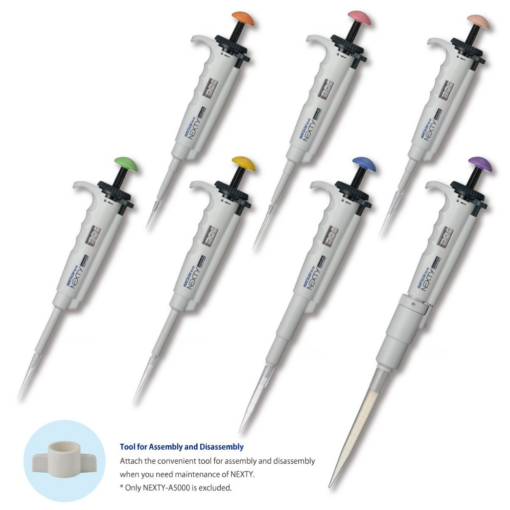
Fully autoclavable single-channel pipette from Watson, built in Japan by Fukae Kasei. Seven models cover 0.2 µL to 5,000 µL, and the complete instrument autoclaves assembled at 121°C for 20 minutes rather than the lower shaft alone. Every model carries published maintenance part numbers, so seal and O-ring replacement stays a bench job.
Watson NEXTY is a fully autoclavable pipette Thailand laboratories can strip, service, and sterilize on the bench. Seven single-channel models cover 0.2 µL to 5,000 µL. Fukae Kasei builds the range in Japan, and the whole instrument goes into the autoclave assembled.
What “fully autoclavable” changes in practice
Many pipettes autoclave only the lower shaft. So the handle, the volume mechanism, and the digital indicator stay outside the load, and any organism riding on those surfaces survives the cycle.
The NEXTY autoclaves whole, at 121°C for 20 minutes, with no stripping down first. For a food microbiology laboratory moving between raw sample preparation and enrichment, that closes one of the quieter cross-contamination routes on the bench. It matters most where one technician handles both stages, which in most Thai QA laboratories is exactly what happens.
How do you autoclave a pipette without losing precision?
Load the pipettes loose, and never pile them on one another. Watson also warns against loading a pipette nozzle-down. Then run the standard cycle: 121°C for 20 minutes, whole instrument, no disassembly.
Drying is the step laboratories skip, and it costs them. Watson specifies room-temperature drying, with a 50°C drying cabinet as the preferred method. Wait until the pipette returns to room temperature before using it again.
Here is why that wait matters. A droplet left inside the body, or a pipette worked while still warm, degrades precision directly. So a rushed turnaround does not merely risk the instrument — it puts an error into the results, and nothing on the bench reveals it.
Handle the pipette with care after the cycle. Watson’s manual warns against touching it by hand straight out of the autoclave or the drying cabinet, since the body comes out hot enough to burn.
Between cycles, routine cleaning uses household or laboratory cleaning agents. Watson also permits 60% isopropanol where sterilization is needed without a full cycle. After either, wipe the pipette with a cloth wetted in distilled water, then dry at room temperature. Never clean with acetone or other highly reactive solvents.
Why accuracy changes across the volume range
Here is the specification most buyers misread. A pipette does not hold one accuracy figure across its range. Accuracy sits worst at the bottom of the range and best near the top, and the gap is large.
Take the WAT-NT-A2. At its maximum 2 µL it delivers ±2.5%. At its minimum 0.2 µL the same instrument delivers ±15.0%. Nothing is wrong with the pipette — that behavior follows from the air-cushion plunger design, because the dead-air volume in the tip stays roughly constant while the dispensed volume shrinks.
So the practical rule follows directly. Choose the model whose range places your routine working volume in its upper half. A laboratory pipetting 15 µL all day should reach for the WAT-NT-A20 rather than the WAT-NT-A100, even though both cover the volume. The WAT-NT-A20 holds ±1.0% at 20 µL, while the WAT-NT-A100 holds ±2.0% at its 10 µL floor.
That single decision moves more analytical error than most calibration programs do.
Specifications
Watson publishes accuracy and precision at both ends of every range, in absolute and relative terms.
| Cat. No. | Volume range | Button color | Min. scale | Accuracy at min / max | Precision CV% at min / max |
| WAT-NT-A2 | 0.2–2 µL | Orange | 0.001 µL | ±0.03 µL (±15%) / ±0.05 µL (±2.5%) | ≤8.0% / ≤1.0% |
| WAT-NT-A10 | 1–10 µL | Pink | 0.01 µL | ±0.05 µL (±5.0%) / ±0.10 µL (±1.0%) | ≤2.5% / ≤0.5% |
| WAT-NT-A20 | 2–20 µL | Beige | 0.01 µL | ±0.12 µL (±6.0%) / ±0.20 µL (±1.0%) | ≤3.0% / ≤0.5% |
| WAT-NT-A100 | 10–100 µL | Green | 0.1 µL | ±0.20 µL (±2.0%) / ±0.80 µL (±0.8%) | ≤1.0% / ≤0.3% |
| WAT-NT-A200 | 20–200 µL | Yellow | 0.1 µL | ±0.40 µL (±2.0%) / ±1.60 µL (±0.8%) | ≤1.0% / ≤0.3% |
| WAT-NT-A1000 | 100–1,000 µL | Blue | 1 µL | ±2.00 µL (±2.0%) / ±8.00 µL (±0.8%) | ≤0.6% / ≤0.3% |
| WAT-NT-A5000 | 500–5,000 µL | Purple | 5 µL | ±10.0 µL (±2.0%) / ±40.0 µL (±0.8%) | ≤0.6% / ≤0.3% |
Watson measured these figures gravimetrically on a microbalance, using purified water at 20–25°C and relative humidity at or below 50%, with Watson brand tips fitted. Conditions matter when you verify in-house, because a Bangkok laboratory running at 65% humidity and 28°C will not reproduce the numbers exactly.
Accuracy describes how close the mean delivered volume sits to the setting, while precision describes how tightly repeated deliveries cluster. Both matter, but they fail differently. Drifting accuracy usually points to a worn seal. Widening precision usually points to technique.
Every model ships as a single unit, and the minimum scale is one thousandth of the maximum volume.
Why the accuracy figures assume Watson tips
Watson states the condition plainly: those specifications were measured with Watson brand tips, and the manual instructs users to fit Watson tips for accurate pipetting. Each model also has one calibrated tip code, though several others fit mechanically.
That distinction deserves attention rather than a footnote. Laboratories routinely buy generic tips on price, then chase a calibration drift that started at the tip box. So if your method sits close to a specification limit, stay on the calibrated tip, and record the change in your method file if you ever switch.
Calibrated tip codes: 204 for the WAT-NT-A2, 207 for the WAT-NT-A10, 705 for the WAT-NT-A20, WAT-NT-A100 and WAT-NT-A200, 706 for the WAT-NT-A1000, and 401 for the WAT-NT-A5000.
Pre-wetting: the free correction most laboratories skip
Watson recommends pre-wetting every new tip. Aspirate and discharge the actual sample two or three times before the delivery that counts, then confirm the blow-out stroke has emptied the tip.
Three things happen during pre-wetting. Pressures equalize across tip, pipette and sample. Temperatures equalize too. Most importantly, liquids that wet polypropylene readily — serum, anything with surfactant — form a film on the inner wall of a dry tip, and that film reduces the volume discharged.
So a technician who skips pre-wetting on a surfactant-containing sample delivers less than the setting says, consistently, in the same direction. Calibration will not catch it, because calibration runs on water.
Two further points from the manual are worth building into your SOP. Dip the tip about 3 mm below the liquid surface, no deeper. Also, hold pipette, tips and samples at the same temperature before use.
What you can service yourself
Watson publishes a full maintenance parts list with part numbers for every model — nozzle cone, eject cone, plunger, plunger seal, O-ring, seal cone, spring washers, springs, and plunger protection sheet. Each model carries its own part numbers.
A dedicated assembly jig ships with the pipette for removing and refitting the nozzle cone. The WAT-NT-A5000 differs: it has a screw-on eject cone, and its nozzle cone comes away without the jig.
The manual also carries a troubleshooting table that names the cause behind each symptom. Liquid left in the tip points to a dirty tip wall. A dropping volume points to a loose tip, high sample volatility, or a leak at the plunger seal, the O-ring, or the bottom parts. A stiff push button points to a dirty plunger or seal, and sometimes to organic solvent or corrosive gas passing through the instrument.
For a Thai laboratory, published part numbers carry a specific value. A seal replacement becomes a bench job rather than an instrument shipped abroad and a month of downtime.
When does it need factory calibration?
Watson routes accurate calibration back through the distributor, because the procedure needs a conditioned room, a microbalance, and practiced technique. The manufacturer restores the pipette to pre-shipment condition and returns it.
Send the pipette to us for that work. In-house gravimetric verification still belongs on your schedule between services, since it tells you when a pipette has drifted rather than correcting it.
What this pipette does not do
It handles liquids unlike water less reliably. Watson tells users to check the polypropylene tip for chemical resistance before pipetting organic solvents or highly reactive substances, and to watch delivered volume closely with volatile liquids or any sample whose physical properties differ from water. Viscous and dense samples belong on a positive-displacement instrument.
It does not replace a calibration program. Autoclaving is a thermal cycle, and thermal cycles work on seals over time. So gravimetric verification stays on your schedule regardless.
These seven models are single-channel. Watson’s multichannel autoclavable range is the NEXTY-S series, a separate line with its own catalog numbers.
One fact stays off this page until Watson confirms it in writing: any declaration of conformity to ISO 8655. Auditors ask for it, and the manual does not mention it. Ask us, and we will get the manufacturer’s answer rather than a guess.
Who uses this in Thailand
Food and beverage QA laboratories running pathogen work, where one bench handles raw sample and enrichment. Seafood and poultry processors preparing export documentation. University and research laboratories running molecular workflows. Water testing laboratories running membrane filtration and dilution series. Feed mills running mycotoxin extractions.
One thread runs through all of them. Repeated pipetting under a contamination constraint, where somebody signs off on the number at the end.
Choosing between the seven models
Start from the volume you pipette most often, not the widest range you might ever need. Then pick the model that puts that volume above the midpoint of its range.
A laboratory building a first set usually takes three: WAT-NT-A10, WAT-NT-A100 and WAT-NT-A1000. That combination covers most microbiology and chemistry workflows without stacking two pipettes on one volume. Next, add the WAT-NT-A2 only if sub-microliter work is routine, and the WAT-NT-A5000 only for bulk media handling.
Color-coded push buttons help on a shared bench, since each model carries its own color and a technician can identify the right instrument without reading the volume window.
Ordering
BCST supplies the full Watson autoclavable pipette Thailand range, and all seven catalog numbers run through us as Watson’s distributor. Order tips separately. We will confirm the calibrated tip code against the model you select. Tell us the volumes you run most often, and we will size the set rather than quote the catalog back at you.
| Volume Range | 0.2–2 µL, 1–10 µL, 2–20 µL, 10–100 µL, 20–200 µL, 100–1,000 µL, 500–5,000 µL |
|---|