

Potato Starch Glucose Test Paper Thailand — Rapid Glucose Detection for Potato Processing | BCST
2,878.30 ฿
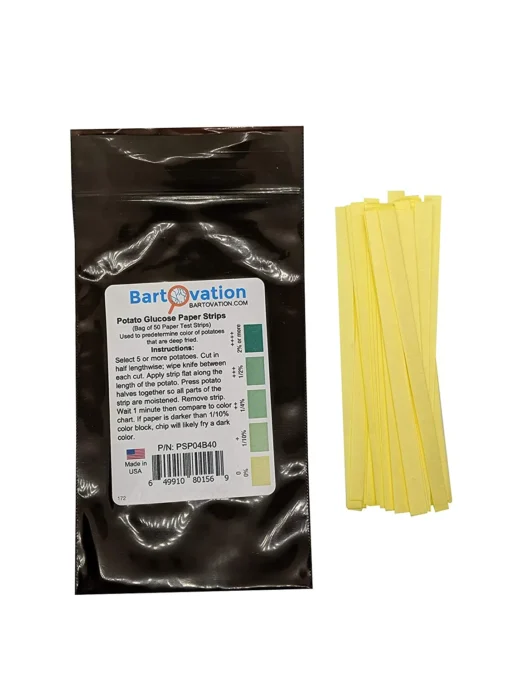
The Bartovation Potato Starch Glucose Test Paper, available in Thailand through BCST, provides rapid, field-ready detection of glucose levels in potato starch and potato processing applications — from 0 to 2%, in a bag of 50 paper strips that require no instruments, no reagents, and no laboratory setup.
BAR-PSP05B50 — Potato Starch Glucose Test Paper, 0–2% glucose. Bag of 50 paper strips.
Applications include potato processing quality control, starch conversion monitoring, raw potato glucose level assessment for frying suitability, and educational demonstration of enzymatic starch-to-glucose conversion.
Contact BCST for pricing and availability.
Available on backorder
Potato Glucose Test Paper in Thailand — Why Glucose Monitoring Matters
Potato glucose test paper, available in Thailand through BCST, addresses a monitoring requirement that sits at the intersection of raw material quality, process control, and finished product consistency — the glucose content of potato starch and potato processing streams. Glucose level in potatoes and potato starch affects multiple downstream quality parameters. In frying applications, high reducing sugar content — primarily glucose — causes excessive Maillard browning, producing dark-colored fried products that fail visual quality standards and, more importantly, generate elevated acrylamide levels — a food safety concern documented by the European Food Safety Authority. Specifically, in starch processing, glucose content indicates the degree of enzymatic or acid hydrolysis conversion. This makes it a direct process control parameter.
Bartovation potato glucose test paper gives processors and quality teams an immediate, field-ready glucose reading. No laboratory instrumentation is required. Furthermore, the paper strip format is fast, cost-effective, and straightforward enough to deploy at the raw material intake stage, at multiple process checkpoints, and at finished product verification — giving any operation the data it needs to make informed decisions about raw material acceptance and process parameters.
BCST distributes BAR-PSP05B50 in Thailand for potato processing operations, food production facilities, research applications, and educational use.
Product Specifications
| Parameter | Detail |
| BCST Cat. No. | BAR-PSP05B50 |
| Bartovation Product Code | PSP05B50 |
| Product | Potato Starch Glucose Test Paper |
| Test range | 0–2% glucose |
| Format | Paper strips |
| Pack size | Bag of 50 paper strips |
| Primary application | Potato starch and potato processing glucose monitoring |
| Measurement method | Color comparison |
| Storage | Cool, dry, out of direct sunlight — zip bag in humid climates |
| Shelf life | As stated on packaging |
| Manufacturer | Bartovation LLC, New York, USA |
The Science — How the Test Paper Works
Potato Glucose Test Paper — Detection Chemistry
The test paper contains a glucose-specific enzyme system — typically glucose oxidase and peroxidase, enzymes used widely in food analysis and diagnostic applications — combined with a chromogenic indicator. When the paper contacts a glucose-containing solution, the glucose oxidase converts glucose and oxygen to gluconic acid and hydrogen peroxide. The reaction is rapid and specific to glucose. As a result, the peroxidase uses the hydrogen peroxide to oxidize the chromogenic indicator, producing a color change proportional to the glucose concentration. The operator compares the developed color against the color chart to determine the glucose level.
Why Glucose Specifically — Not Total Reducing Sugars
This test paper measures glucose specifically, not total reducing sugars. In potato processing applications, glucose and fructose are the primary monosaccharides of concern — and glucose is the dominant one. In contrast, glucose-specific testing avoids interference from sucrose and other non-reducing sugars. These are present in raw potato material but do not contribute to Maillard browning or acrylamide formation in the same way that reducing sugars do. Consequently, a glucose-specific result gives a more directly actionable indicator of frying quality risk than a total reducing sugar measurement.
Applications
Potato Processing Quality Control
Potato processors in Thailand use glucose test paper to assess incoming raw potato batches for glucose content before acceptance. Potatoes stored at low temperatures undergo starch-to-sugar conversion — called cold sweetening. This process raises glucose levels and makes the potato unsuitable for high-quality chip or crisp production. Consequently, rapid field testing at goods receipt allows processors to reject or re-route high-glucose batches before they enter the production line.
Frying Suitability Assessment
Deep frying operations using potato products — including chips, crisps, fries, and battered potato products — rely on consistent glucose levels in raw material to achieve predictable color development in the fryer. Specifically, potatoes with glucose above approximately 0.1% produce darker-than-acceptable fried colors. They also generate acrylamide at levels that may trigger regulatory or buyer concerns. Glucose test paper gives production teams an immediate pre-frying assessment that supports consistent color and quality standards.
Starch Conversion Monitoring
In enzymatic starch hydrolysis — converting potato starch to glucose syrup or maltodextrin — glucose test paper provides a rapid in-process check. It does so without the delay of laboratory HPLC analysis. Moreover, it allows process operators to make real-time decisions about enzyme addition, reaction time, and temperature adjustment based on current glucose level data.
Educational and Research Applications
Additionally, potato glucose test paper is used in food science education to demonstrate starch hydrolysis, enzymatic conversion, and the relationship between raw material composition and finished product quality. Research institutions use it for rapid screening in plant breeding programs where low-reducing-sugar potato varieties are developed for the food processing industry.
How to Use the Potato Glucose Test Paper
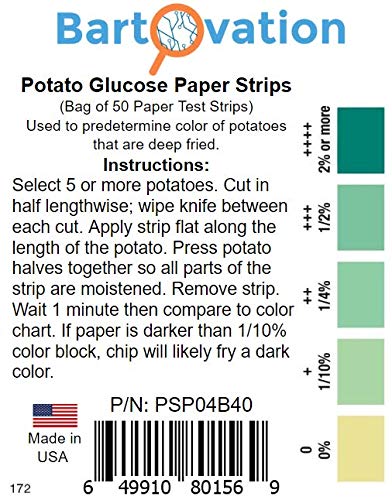
Prepare a water extract of your potato sample or dilute your process stream to within the 0–2% glucose test range. Dip the paper strip into the sample solution and remove immediately. After the specified development time, compare the color against the printed reference chart. Consult the color chart on the packaging for exact timing. Record the result and compare against your facility’s acceptance specifications.
For solid samples such as raw potato, grate or juice the potato and extract the liquid before testing. Ensure the extract reaches room temperature first. Temperature affects enzyme kinetics and may reduce color development accuracy if the sample is too cold or too warm.
Frequently Asked Questions
Q: Can this test paper be used on cooked potato products as well as raw potato?
The test paper measures glucose in solution. For cooked potato products, prepare a water extract of the cooked material and test the extract. However, bear in mind that cooking affects the starch-sugar balance — cooked potato extracts will give a different glucose reading than raw potato extracts from the same potato. The appropriate application context for quality control is raw material assessment before processing.
Q: Is this test paper suitable for use in HACCP or food safety management systems?
This test paper provides a rapid field screening result. It is appropriate for use as a quality control screening tool within a HACCP or food quality management system. For regulatory reporting or formal specification compliance documentation, confirm positive or borderline results with a validated laboratory method such as HPLC or enzymatic glucose assay. For international HACCP guidance, refer to the Codex Alimentarius General Principles of Food Hygiene.
Q: What is the sensitivity of the test paper?
The test range is 0–2% glucose. For potato processing applications, this covers the relevant range from very low glucose — a high-quality processing potato — through high glucose — a cold-sweetened or stress-damaged potato unsuitable for high-quality frying. Contact BCST if your application requires measurement outside this range.
Q: How should I store these strips in Thailand’s humid climate?
Store the bag in a cool, dry location away from direct sunlight. In Thailand’s humid climate, Bartovation recommends keeping paper strip products in a zip bag between uses. Humidity degrades the enzyme chemistry in the paper and can cause false readings or color development in the absence of glucose. Keep the original bag tightly sealed at all times when not in use.
Q: What documentation can BCST provide?
BCST provides SDS exemption documentation for BAR-PSP05B50 on request. Specify your documentation requirements at the time of order.
Order Potato Glucose Test Paper in Thailand
Bartovation potato glucose test paper is available in Thailand through BCST — Biochem Scitech Co., Ltd. Potato processors, food production facilities, research institutions, and food science educators across Thailand use this product for rapid, field-ready glucose monitoring. Contact BCST for current pricing, stock availability, and lead times.
Reach BCST via the contact form on this page, by email at sales@bcst.co.th, or by phone at +66-92-4289163. Provide your required quantity and BCST will respond with a formal quotation.
For the complete BCST food safety and quality testing product portfolio, visit the BCST product catalogue.
[Enquire or Order Now]